General Wastage
Broad uniform thinning, predictable from class allowance tables and UTM trends.
Vesselspect fuses photos, thickness records, and expert review to map structural condition, rank findings by risk, and draft repair scope.
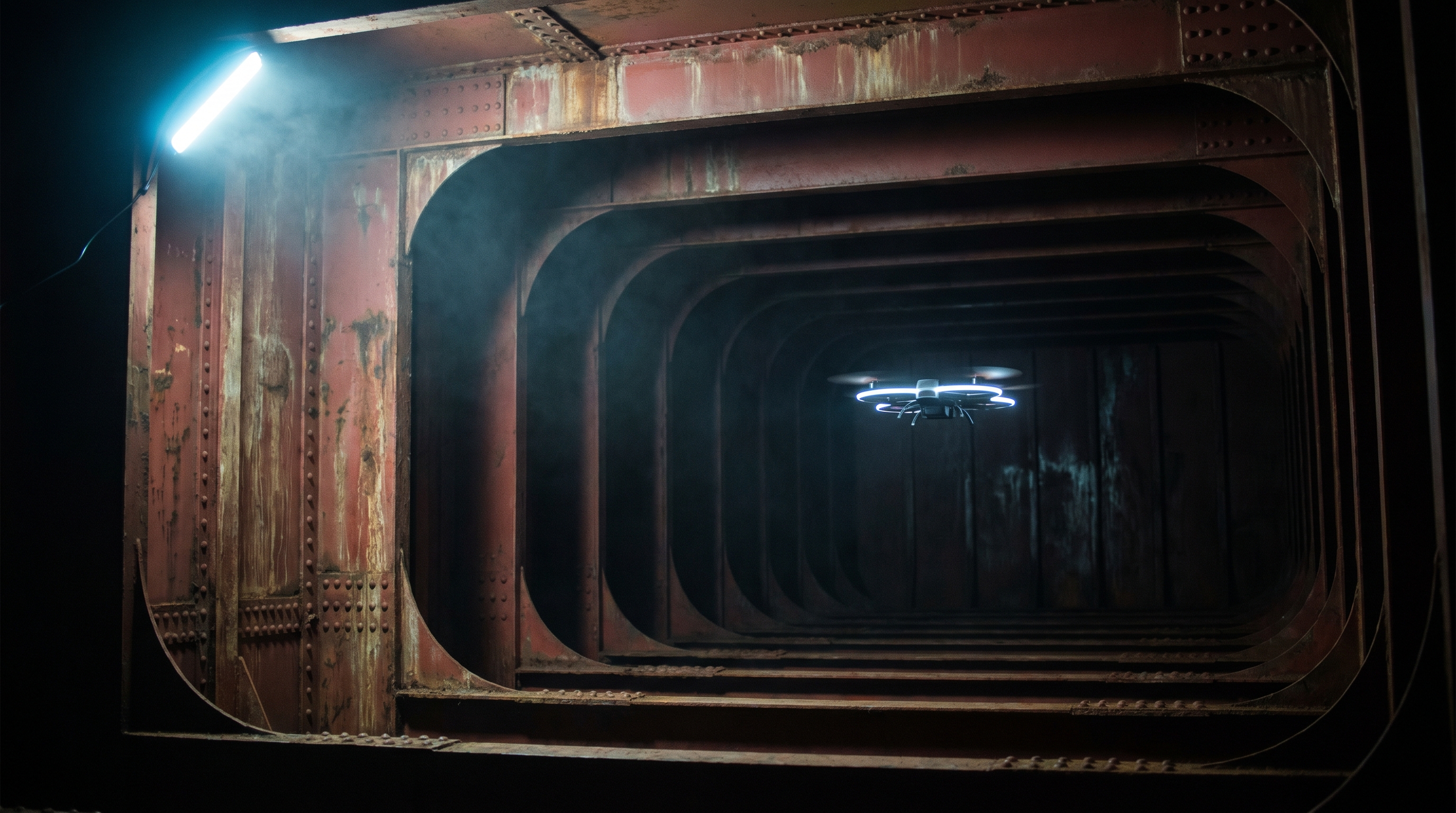
Surveys don’t talk to each other
Photos go in one folder. Notes in another. Thickness readings in a spreadsheet. Two surveyors look at the same tank and write reports that don’t compare.
A zone’s history gets stitched together by hand on every survey. Patterns across sister ships — corrosion rates by operating profile, recurrent failure at hopper knuckles and manholes — stay invisible. The data never escapes individual reports.
The missing piece is the layer between inspection and decision. One that holds the evidence, the thickness history, and the expert review for each zone — and keeps that record alive across surveys, vessels, and class cycles.
Three layers · one record per zone
Capture data. Fuse it to the zone it came from. Hand surveyors a ranked worklist and a draft repair scope.
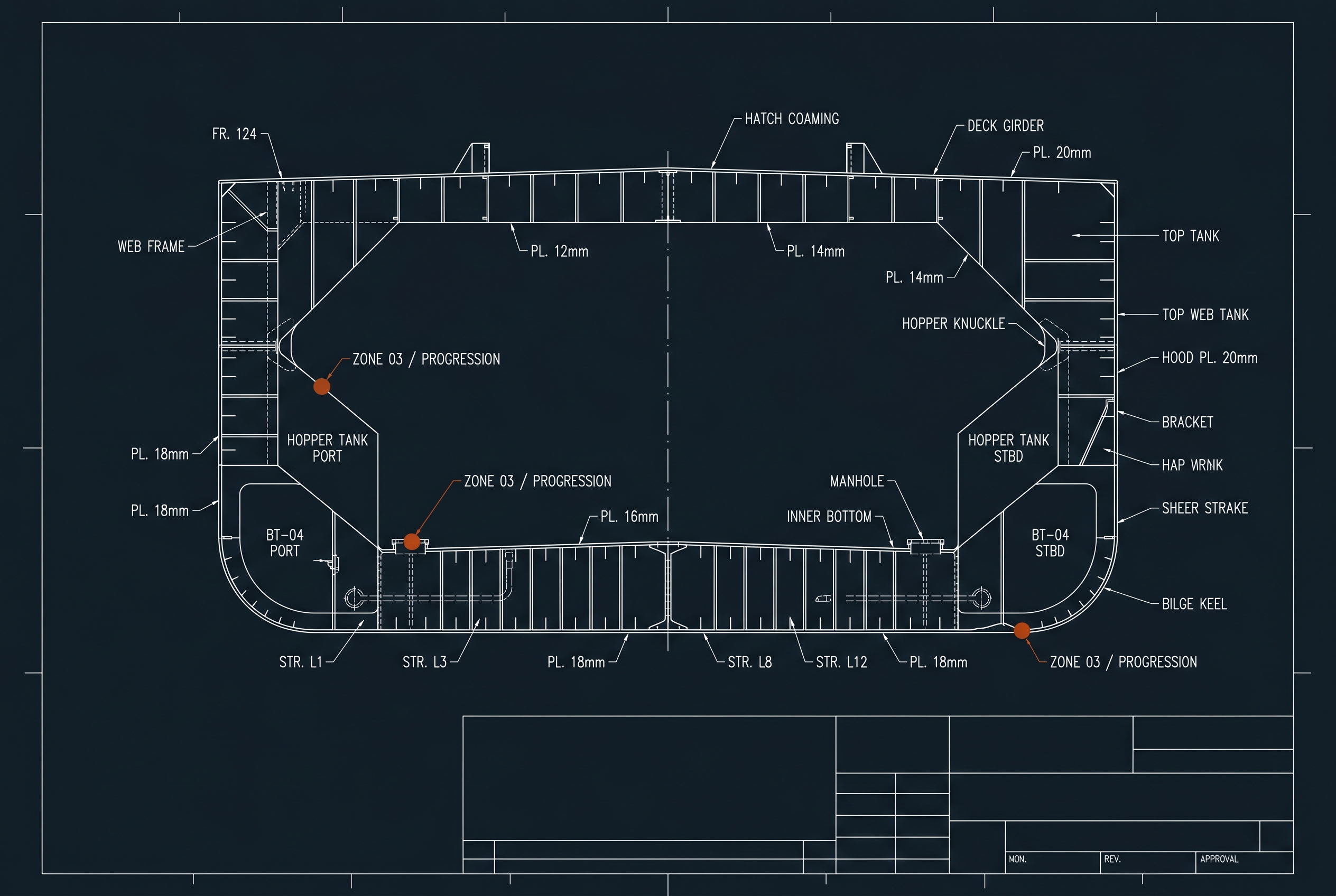
Drones, crawlers, remote inspection providers, manual surveys — Vesselspect treats them all as inputs. Every photo and every probe reading lands tied to a repeatable survey zone, not a folder name.
Photos and certified UTM are first-class. Thermal, PEC, hyperspectral, and 3D get folded in where they earn their keep. Quality gates catch poor coverage or weak imagery before it hits the rest of the workflow.
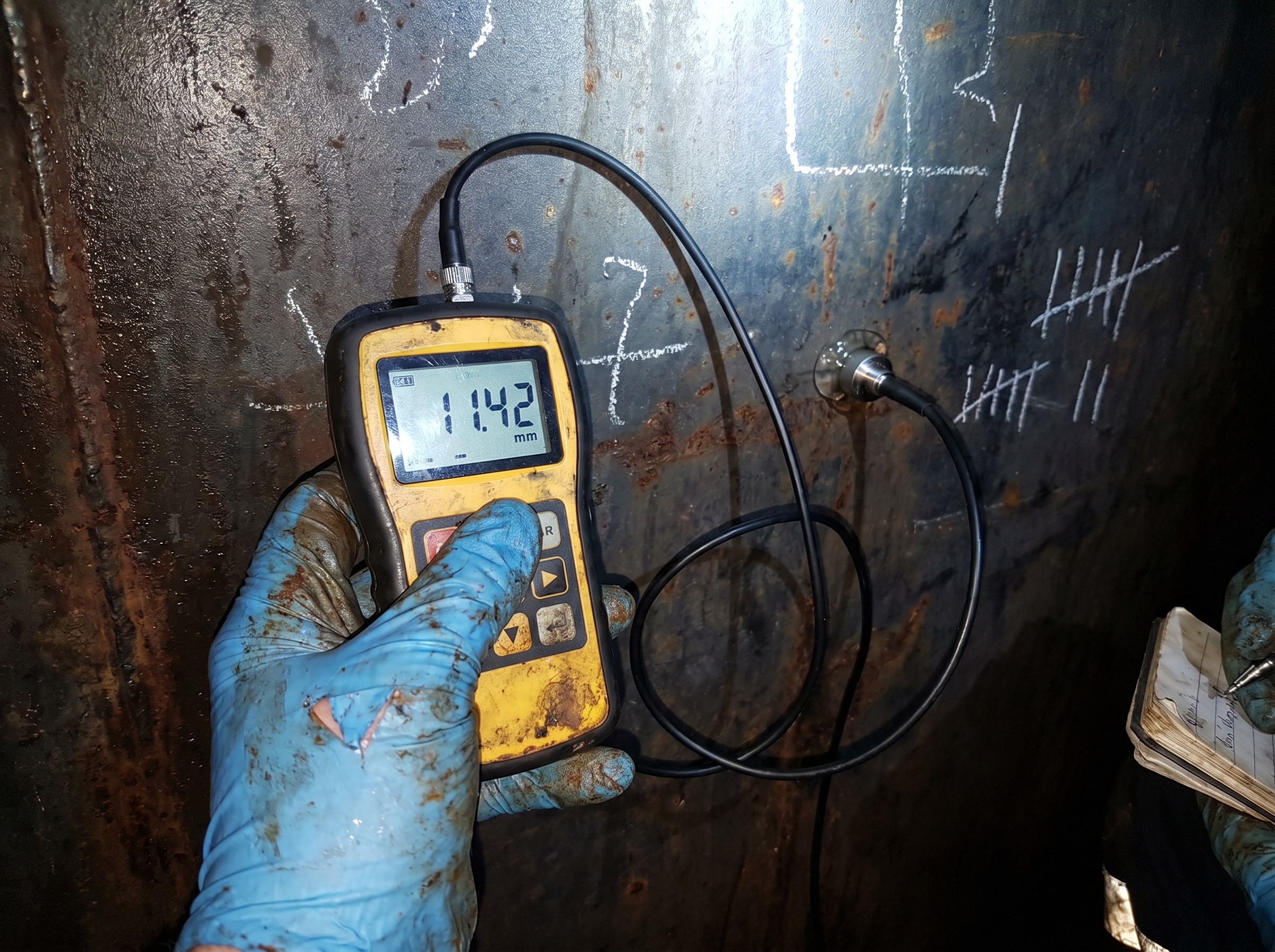
Photos, thickness readings, repair history, and operating context all anchor to the same structural member. Corrosion evidence and metal-loss evidence finally get read together, not in parallel spreadsheets.
Each input is weighted by modality, coverage, age, and confidence. Repeat data drives trend review. Surveyors, naval architects, and repair specialists set the rules — for corrosion traps, confirmation logic, and escalation thresholds.
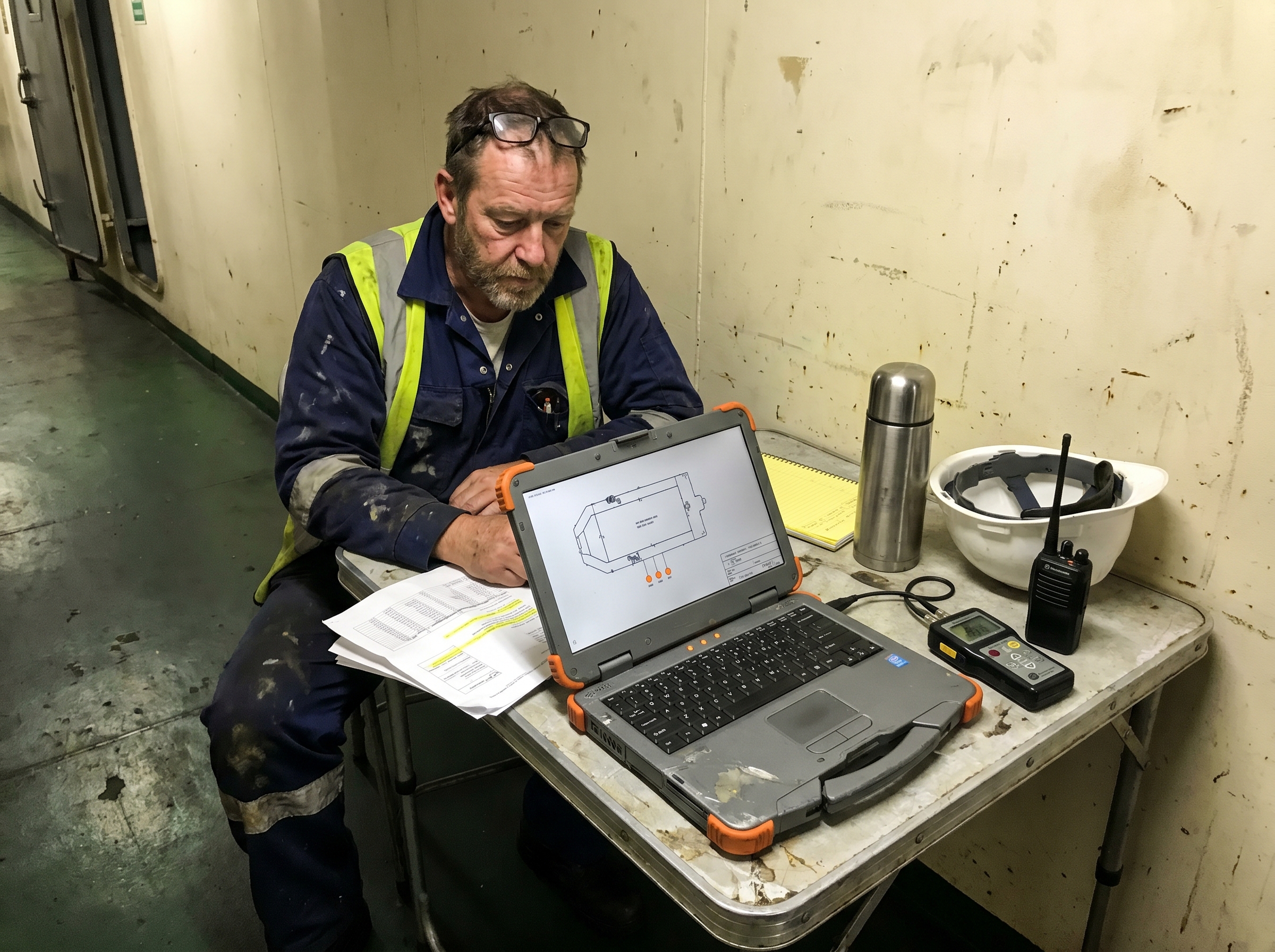
Vesselspect ranks zones by risk and tells you what to do next: recapture, UTM confirmation, close-up survey, or a draft intervention scope. Image severity is one input among several — structural context, confirmed thickness, history, and operating exposure all weigh in.
Approval stays with the surveyor or operator. Every output traces back to the zone, the evidence, and the reasoning. Nothing ships without sign-off.
Mechanism drives both how fast steel goes and how much it matters. Vesselspect classifies findings by mechanism, then applies the right degradation model and the right urgency threshold.
Broad uniform thinning, predictable from class allowance tables and UTM trends.
Localised deep attack at weld toes, ballast-tank corners and coating-breakdown points. Assessed against UR-Z10 pit density and depth criteria.
Along welds and stiffener-to-plate intersections. Associated with residual stress; sensitive to coating coverage and cyclic wetting.
At lap joints, bracket slots and structural connections — driven by differential aeration in stagnant ballast water.
Near sacrificial anodes and dissimilar-metal contacts; rate falls off with anode depletion and inverse distance.
Microbiologically influenced corrosion. In partially flooded areas, anaerobic sulphate-reducing bacteria accelerate local wastage well beyond electrochemical rates.
Photos and certified thickness readings are the baseline. Thermal, PEC, hyperspectral, and 3D get added only where they pass explicit criteria — and where class accepts them.
| Modality | What it answers | Phase | Status |
|---|---|---|---|
| RGB / Visual | Coating breakdown, corrosion mapping, crack & deformation screening. | P1 | Core |
| UTM — Ultrasonic | Absolute remaining thickness vs class minima; the quantitative reference for class. | P1 | Core · class-accepted |
| Radiometric Thermal | Subsurface moisture, delamination, coating disbond signatures under passive conditions. | P1 | Optional payload |
| Pulsed Eddy Current (PEC) | Relative wall-loss screening through coatings, without couplant — UTM confirms absolutes. | P2 | Bounded pilot |
| Hyperspectral (VNIR 350–1000 nm) | Coating composition, UV/chemical degradation, early sub-coating corrosion signatures. | P2 | Bounded pilot |
| Local Geometry / 3D | Deformation, buckling, dent mapping on flagged structure. | P2 / P3 | Optional |
Capture, fusion, and decision-support are separate services. The zone-aligned record threads them — and lives across surveys, vessels, and class cycles.
Plan the mission. Check image quality. Register every frame to a zone. Place UTM where it matters. Re-shoot what falls short.
Evidence lines up to the same structural member. Findings get classified by mechanism. Risk gets scored with a fleet-wide prior. Change maps make progression visible.
Ranked worklist. Next-step recommendation per zone — recapture, UTM, close-up, or draft repair scope. Every output traces back to the evidence.
| Typical Inspection Workflow | Vesselspect | |
|---|---|---|
| What it finds | Defects in photos. Thickness at sampled points. | Visible deterioration and confirmed thickness, tied to the structural zone. |
| Under the coating | Limited or none. | Thermal and PEC cues, weighted by proven capability. |
| What a location means | A pixel on an image. | A structural zone with member type, history, and operational context. |
| How priority is set | Visual severity, or spot sampling. | Evidence + visual severity + thickness + zone importance + trend. |
| What history shows | Disconnected snapshots per survey. | Long-running records: stable, spreading, or accelerating per zone. |
| What happens next | Surveyor decides everything manually. | Recommended next step per zone — recapture, UTM, close-up, or draft repair scope. |
| What gets learned across the fleet | Issues, one vessel at a time. | Patterns by class: repeat problem zones, corrosion by operating profile, what coatings actually hold up. |
Photos and targeted UTM in ballast tanks and cargo holds. Surveyor signs off every flagged zone.
Bring in PEC and hyperspectral on flagged zones. Evaluate active thermography. Establish fleet baselines.
Open the data layer to class, operators, and inspection providers via API. Add validated NDT payloads.
Applied maths for routing and degradation models. Physics for surface and uncertainty. Maritime structures for class-rule mapping. AI engineering to ship it.

Algebraic number theory; research on drone guidance. Routes drones, models corrosion, runs fleet-wide Bayesian inference.

TUM Aerospace, IIT Delhi Mechanical, and former ISRO scientist. Maps robotic data onto IACS zones and survey task cards.
Managed international research groups in XAI and robotics. Contributes to technology management and product strategy.

BEng in Computer Software Engineering. Delivers AI products end-to-end: NLP, reporting, automation. Contributes to codifying the inspection expertise, CAD modelling, 3D design, and engineering development.
No. Final survey calls and class sign-off stay with certified surveyors. Vesselspect is a documented survey-support layer that strengthens existing workflows — not a class authority.
AI does triage and prioritisation. Every finding has a human review threshold. Outputs are calibrated, surveyor-reviewable findings — not black-box probabilities.
No. Vesselspect treats robotic acquisition as input. Evidence can come from drones, crawlers, remote-inspection providers, or manual survey teams. Vendor-agnostic by design.
It starts from class drawings and survey-zone references, then builds the record up over time. Access to historical drawings and thickness logs helps — but isn’t required.
Vessel-identifying data stays with the operator. Aggregated patterns — corrosion rates by zone type, coating performance by cargo profile — only get shared under explicit data-rights and confidentiality terms.
Condition maps. Ranked findings. Repair scope. Grounded in your vessel data.
Get in touch